Housing Placement Rates: Impact of 2025 Policy Changes
DEMONSTRATION PROJECT - FICTIONAL DATA
SYNTHETIC DATA SETEvaluation Question
Did the 2025 housing policy changes affect client housing success?
Results
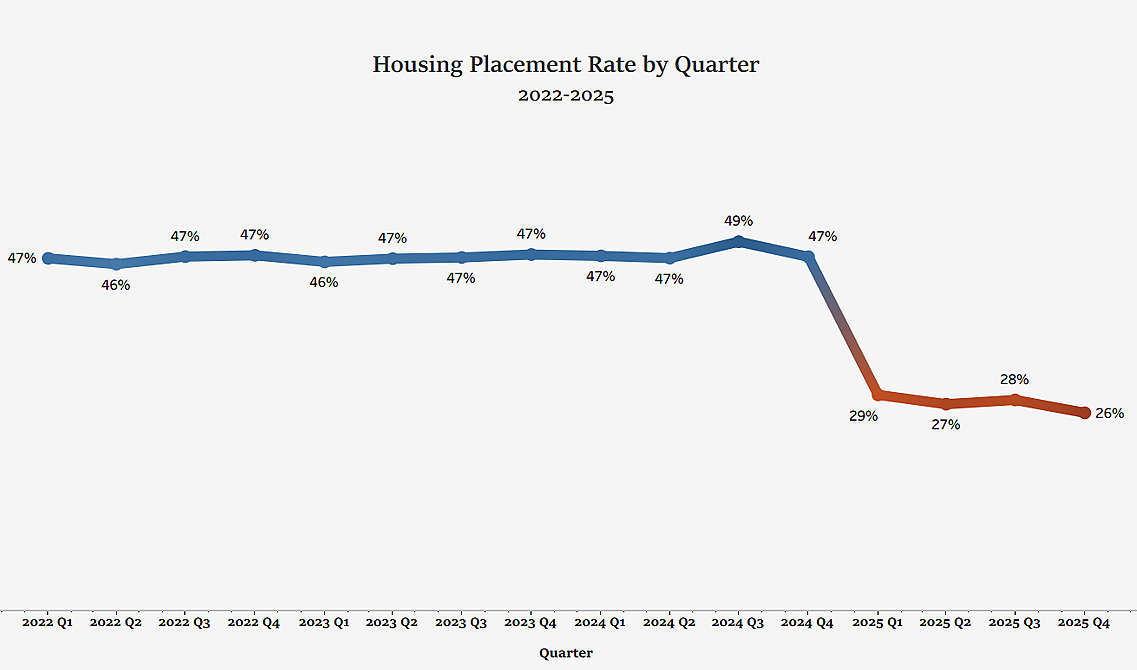
Housing placement rates fell sharply after 2025, independent of program type and client population served.
Statistical modeling indicates an average 19.7% percentage point drop in placement rates from before the policy changes to after they took effect. This is consistent with structural, system-level change rather than a program or population specific effect.
-
Test performed: Multiple linear regression
R² - 0.978
Adjusted R² - 0.977
Standard error - 0.0450
F-statistic - 1551.4***
Observations - 432The model accounts for 97.8% of the variance in placement rates, and the F-statistic (p < 0.001) indicates the model is highly statistically significant as a whole.
Built on a synthetic dataset designed to illustrate methodology, not observed outcomes from a real Continuum of Care.
-
Transitional Housing - coefficient 0.240
Rapid Re-Housing - coefficient 0.484
Permanent Supportive Housing - coefficient 0.799
Prevention - coefficient 0.563
Capacity utilization - coefficient 0.155 (p = 0.001)
Post-2025 policy period - coefficient −0.197
-
Item descriptionThis analysis uses a synthetic dataset to demonstrate the methodology rather than represent real-world outcomes. A live analysis would likely differ in several ways:
Model fit - An R² this high would be unusual in real world CoC data. Placement outcomes are influenced by factors such as staffing, client circumstances, and local referral pathways that aren't fully captured in the model.
Data quality - This analysis assumes clean and complete records. Real HMIS data often includes missing fields, inconsistent data entry, and differences in how agencies document services.
Confounding factors - The synthetic data treats the 2025 policy change as the primary driver of the outcome. In practice, changes in funding, staffing, economic conditions, and other factors may occur at the same time, making it harder to isolate the effect of a single policy change.